Showing posts with label The Church. Show all posts

Thursday, August 14, 2014

St. Maximilian Kolbe, Martyr

Many people are at least somewhat familiar with the saint whose feast day the Catholic Church celebrates today — namely, St. Maximilian Kolbe, who voluntarily gave up his life in Auschwitz in 1941 to spare the life of one Franciszek Gajowniczek.

But what is lesser known is that during the canonization process, a controversy arose in the Church as to whether or not Father Kolbe should be regarded as a martyr.

George Weigel writes in Witness to Hope:

The Pope [John Paul II] has regularly reminded the world that the twentieth century is the greatest century of martyrdom – faithful witness unto death – in Christian history. And no martyr of the twentieth century has been, for John Paul, a more luminous icon of the call to holiness through radical, self-giving love than Maximilian Kolbe. Kolbe was the "saint of the abyss" – the man who looked straight into the modern heart of darkness and remained faithful to Christ by sacrificing his life for another in the Auschwitz starvation bunker while helping his cellmates die with dignity and hope.

Kolbe’s canonization was set for St. Peter’s Square on Sunday, October 10, 1982. But a question had arisen. Father Kolbe was widely regarded as a martyr, but was he a "martyr" in the technical sense of the term – someone who had died because of odium fidei, "hatred of the faith"? He had not been arrested because of odium fidei, and witnesses to his self-sacrifice had testified that the Auschwitz commandant, Fritsch, had simply accepted Kolbe’s self-substitution for the condemned Franciszek Gajowniczek without evincing any particular satisfaction that he was killing a priest. The theologians and experts of the Congregation for the Causes of Saints… had argued that Kolbe, while undoubtedly a saint, was not a martyr in the traditional sense of the term. At Kolbe’s beatification in 1971, Pope Paul VI had said that Kolbe could be considered a "martyr of charity," but this was a personal gesture and the category lacked standing in theology or canon law. Since then, though, the Polish and German bishops had petitioned the Holy See that Kolbe be canonized as a martyr, rather than as a saintly confessor who happened to have died under extraordinary circumstances.

John Paul II appointed two special judges to consider the question from the theological and historical points of view. Their reports were then submitted to a special advisory commission. The majority of the commission concluded that Blessed Maximilian Kolbe’s self-sacrifice did not satisfy the traditional criteria for martyrdom, heroic as it undoubtedly was. On the day of his canonization, it was unclear whether Kolbe would be given the accolade of a martyr, as many Poles, Germans, and others wished.

On October 10, 1982, a magnificent autumn morning, found a quarter of a million people in St. Peter’s Square, where they saw a great banner, a portrait of Father Kolbe, draped from the central loggia. Still, the question hung in the air: Would Kolbe be recognized as a martyr? The answer came when John Paul II processed out of the basilica and into the square wearing red vestments, the liturgical color of martyrs. He had overridden the counsel of his advisory commission, and in his homily he declared that "in virtue of my apostolic authority, I have decreed that Maximilian Mary Kolbe, who following his beatification was venerated as a confessor, will henceforth be venerated also as a martyr!"

A pope overriding the advice of his advisory commission...shades of Pope Paul VI, methinks.

To those outside the Church — or, for that matter, even many of those within the Church — the question of whether St. Maximilian Kolbe should be regarded as a martyr may seem trivial.

But Weigel goes on to explain why it's so crucial:

John Paul II was making an important theological point in deciding that St. Maximilian Kolbe was indeed a martyr – systematic hatred for the human person (systematic odium hominis, so to speak) was a contemporary equivalent of the traditional criterion for martyrdom, odium fidei. Because Christian faith affirmed the truth about the inalienable dignity of the human person, anyone who hated that truth hated, implicitly, the Christian faith. Modern totalitarianism was an implicit form of odium fidei, because it reduced persons to things.

St. Maximilian Kolbe is the patron saint of drug addicts, political prisoners, families, journalists, prisoners, and the pro-life movement.

St. Maximilian Kolbe, pray for us!

Wednesday, February 13, 2013

It's All about ME!

In 1908, G. K. Chesterton was one of several prominent writer of his day who was asked by the London Times to write an essay on the theme, "What's Wrong with the World?"

In response, Chesterton wrote a letter:

Dear Sirs,

I am.

Sincerely yours,
G. K. Chesterton

Would that all of us were so honest.

We are ever so imperfect, weak, and broken, and so many of the things we say and do are — not to put too find a point on it — wrong, and thus we are are in need of a Redeemer.

Today is the day we have ashes placed on our foreheads and hear the words: "Remember that you are dust and unto dust you shall return."

What a striking contrast between this quintessential memento mori and the contemporary "I'm OK, You're OK, Everyone is OK" Zeitgeist, in which self-approbation and embracing of one’s own foibles are to be esteemed, and acknowledgment of personal sin is to be shunned at all costs.

As we begin Lent, we would do well to remind ourselves that when we fail to accuse ourselves of sin and seek God's mercy and forgiveness, we do so at our own peril.

What's wrong with the world?

I am.

Tuesday, June 26, 2012

"Love Sacrifice, Love the Cross, Love Pain." Seriously?

Today is the feast of St. Josemaria Escriva, the founder of Opus Dei.

Although I am not now nor ever have been a member of Opus Dei, I'm definitely a fan (both of Opus Dei and its founder).

When looking at some of St. Josemaria's writings a few years ago, I came across this counsel:

Love sacrifice; it is a fountain of interior life. Love the Cross, which is an altar of sacrifice. Love pain, until you drink, as Christ did, the very dregs of the chalice.

This is one of those pieces of advice that illustrates with absolutely clarity why, in the midst of our world, really and truly following Our Lord Jesus Christ is the ultimate alternative lifestyle — and, yea, the only one worth living.

As shocking as it sounds, we are indeed called to love sacrifice, to love pain — in short, to love suffering — for in doing so, we unite ourselves to Jesus.

Let's be honest: the notion that we should not only tolerate suffering but actually embrace it and love it sounds, well, crazy. And not just crazy, mind you, but über-crazy.

That is, until we remind ourselves about that whole "Whoever wishes to come after me must deny himself, take up his cross, and follow me" thing.

Jesus loved; so too must we love if we want to be like Him.

Jesus served; so too must we serve if we want to be like Him.

Jesus suffered pain and humiliation; so too must we suffer pain and humiliation if we want to be like Him.

When I first read those words of St. Josemaria, they particularly struck me because I had just recently finished reading The Soul of the Apostolate. Therein, the author, Dom Jean-Baptiste Chautard, lists nine "levels" of the interior life, ranging from "hardened in sin" to "complete sanctity". The latter, he says, have an "ardent thirst for sufferings and humiliations".

At this point in my life, I cannot say I have an ardent thirst for sufferings and humiliations. But, please God, some day I will.

And, please God, some day we all will.


Monday, April 2, 2012

"I Cannot Worship a Guy I Can Beat Up"

A while back, Mark Shea drew attention to some remarks by Pastor Mark "High Octane Calvinism" Driscoll of Seattle's Mars Hills Church:

In Revelation (the last book of the New Testament), Jesus is a prize-fighter with a tattoo down His leg, a sword in His hand and the commitment to make someone bleed. That is the guy I can worship. I cannot worship the hippie, diaper, halo Christ because I cannot worship a guy I can beat up.


Shea remarked: "I’m sure the guards in charge of the scourging at the pillar felt the same way. Surely, the measure of our worship is 'Can I beat up Jesus?'"

His comment prompted me to recall this ancient Eastern icon:


Its name? Christ the Bridegroom.

Think about that for a minute, especially in light of the Events we are preparing to commemorate this week.

Like most men on their wedding day, I went to great lengths to look my best.

And yet, Our Lord and Savior Jesus Christ — the Bridegroom of bridegrooms — is here shown with His hands bound, stripped half naked, having just been mercilessly scourged and crowned with thorns, and as a result so weak that He can't even hold His head up straight.

Yes, Christ the Bridegroom, for just a few hours later He would perform the ultimate act of self-sacrificial love for His Bride the Church — read: us — by laying down His very life for her.

Wednesday, February 22, 2012

It's All about ME!

In 1908, G. K. Chesterton was one of several prominent writer of his day who was asked by the London Times to write an essay on the theme, "What's Wrong with the World?"

In response, Chesterton wrote a letter:

Dear Sirs,

I am.

Sincerely yours,
G. K. Chesterton

Would that all of us were so honest.

We are ever so imperfect, weak, and broken, and so many of the things we say and do are — not to put too find a point on it — wrong, and thus we are are in need of a Redeemer.

Today is the day we have ashes placed on our foreheads and hear the words: "Remember that you are dust and unto dust you shall return."

What a striking contrast between this quintessential memento mori and the contemporary "I'm OK, You're OK, Everyone is OK" Zeitgeist, in which self-approbation and embracing of one’s own foibles are to be esteemed, and acknowledgment of personal sin is to be shunned at all costs.

As we begin Lent, we would do well to remind ourselves that he who fails to accuse himself of sin and seek forgiveness does so at his own peril.

What's wrong with the world?

I am.

Thursday, December 22, 2011

Wednesday, November 30, 2011

“I really only love God as much as I love the person I love the least"

A few years ago a friend of mine told me that he had recently started reading the Fathers of the Church, which, he said, made him feel like "the great slacker of the world."

I had a similar feeling as I read The Soul of the Apostolate a few years back.

This is the effect that good spiritual reading ought to have on us. From it, we learn from holy people (that is, people who are fiercely serious about loving God and one another, along with the Church, Scripture, and Tradition, who are indefatigably committed to prayer and the Sacraments, and who know a thing or two about self-mastery thanks to regular and rigorous penance and mortification) what, with God's grace, we are capable of, and what He put us on this earth to do.

Good spiritual reading also reminds of our own pathetic brokenness, and how far we presently are from reaching a point anywhere close to that reached by the spiritual masters whose works we read.

Sure, no one likes to be reminded of his faults and imperfections, but we periodically need to remind ourselves (or have someone else remind us) of how not-so-good we are, lest we get a little too comfortable with ourselves and become -- God forbid -- proud.

With this in mind, consider these words of Servant of God Dorothy Day, whose death 31 years ago was commemorated yesterday:

“I really only love God as much as I love the person I love the least.”

These words are as good a reality check as any we're likely to come across today. We would all do well to look deep within ourselves and honestly ask:

How much do I really love God?

Monday, September 19, 2011

"We Don't Realize How Dangerous Jesus Was"

My friend Rob Kaczmark from Spirit Juice Studios recently produced a trailer for Father Robert Barron's new TV series, Catholicism.

Check thou it out:


The series will be shown on several public television stations throughout the country starting this week. The full broadcast schedule is here.

Wednesday, August 31, 2011

WYD 2011

BadCatholic blogger Marc Barnes recently posted this video that includes interviews with some brainwashed sheep impressive young Catholics who were among the 1.5 million pilgrims who attended World Youth Day in Madrid earlier this month:

Friday, June 24, 2011

"If The Eucharist Is Just a Symbol, Then to Hell with It"

Some might be scandalized by these words spoken by the sui generis Flannery O'Connor.

That's too bad, because they're absolutely true.

Two days hence is Corpus Christi Sunday, when we remind ourselves that when we attend Mass and receive Holy Communion, each of us had better make sure our own spiritual house is in order, because despite the fact that it looks like bread, tastes like bread, smells like bread, and is, therefore, by all appearances, bread, it is most certainly not bread.

If it were, in and of itself, it would be exactly worthless.

And yet it isn't. On the contrary, the Eucharist is the very Body and Blood, Soul and Divinity of Our Lord Jesus Christ, and as such, it is literally of infinite value. We can never tire of reminding ourselves of that.

Just yesterday I came across the text of a smashingly good address given by Denver Archbishop Charles Chaput to the Catholic Social Workers Association in which he shared O'Connor's aforementioned quip and offered her as an example of someone who was to be commended for her "confidence in the Church or her impatience with the empty conceit of people who want the comfort of faith but not the cost of actually believing and living it."

As is his wont, Chaput pulled no punches and spoke clearly. Here's how his talk begins:

We’re here today — or anyway, we should be here today — because we believe in Jesus Christ. Everything in Catholic social ministry begins and ends with Jesus Christ. If it doesn’t, it isn’t Catholic. And if our social work isn’t deeply, confidently and explicitly Catholic in its identity, then we should stop using the word “Catholic.” It’s that simple.

Faith in Jesus Christ — not as the world likes to imagine him, but the true Son of God as the Catholic Church knows and preaches him — is the only enduring basis for human hope. Real hope has nothing to do with empty political slogans. It has nothing to do with our American addictions to progress or optimism or positive thinking.


This is what we call Getting Back to Basics: the Catholic Church is about nothing if it is not about Jesus Christ. Boom.

Needless to say, the whole address is well worth a read.

This "Getting Back to Basics" idea struck me a few weeks ago when I came across this story about Francesca Sinicrope, a student at a Catholic high school in Canada. This 17-year old girl found herself in the unlikely position of having to defend Church teaching to one of her teachers who apparently told her class that Jesus never rose from the dead, and that the real moral of the story of Jesus' life is that we should all be nice to each other or something.

Reading this, I was reminded me of what Rudolf Bultmann once said: "If the bones of the dead Jesus were discovered tomorrow in a Palestinian tomb, all the essentials of Christianity would remain unchanged" -- words that convey an idea so stupid that they could have only been uttered by a theologian.

Here's the deal: at its heart, the Catholic faith (and Christianity in general) isn't about being nice to people. It's not about helping the poor, or taking of the widow and orphan, or fighting abortion.

It isn't about believing things like masturbation, pornography, contraception, non-marital sex, usury, defrauding laborers of their wages, etc., are sinful.

True, these things are part of the whole Christian scene, but they're not The Thing. At its heart, what the Catholic faith (and Christianity in general) is about is the Resurrection of Jesus Christ from the dead.

Either Jesus rose from the dead, or he didn't.

If he did, then Christianity is true. If he didn't...well, then, boy, aren't we a bunch of idiots.

How much more clearly could St. Paul have made it?

If there is no resurrection of the dead, then neither has Christ been raised. And if Christ has not been raised, then empty (too) is our preaching; empty, too, your faith. Then we are also false witnesses to God, because we testified against God that he raised Christ, whom he did not raise if in fact the dead are not raised.

For if the dead are not raised, neither has Christ been raised, and if Christ has not been raised, your faith is vain; you are still in your sins.

Then those who have fallen asleep in Christ have perished. If for this life only we have hoped in Christ, we are the most pitiable people of all. But now Christ has been raised from the dead, the firstfruits of those who have fallen asleep. (1 Cor. 15: 13-20)


That's why, as for me, if Jesus didn't rise from the dead, I'd renounce my faith yesterday, and I'd tell every other Christian to do the same.

If the Resurrection is just a myth, then to hell with it.

Thursday, May 5, 2011

"Priests Were Not Welcomed by the Nazis"

In yesterday's Chicago Tribune, accompanying a story about Derrick Rose being named the NBA's MVP at age 22 is a feature titled, "Where were you at 22?" that looks at what Some Famous People were doing at that age.

Notice in particular the caption next to Pope John Paul II:


I guess you could say that "priests were not welcomed by the Nazis," but that's a bit of an understatement, don't you think?

Thursday, April 28, 2011

Truer Words Have Never Been Spoken

This morning I came across a piece by Father George Rutler in this month's Magnificat about the much anticipated new translation of the Roman Missal.

In the course of discussing the extreme difficulty of providing an accurate translation of the Bible (or anything, really), he notes:

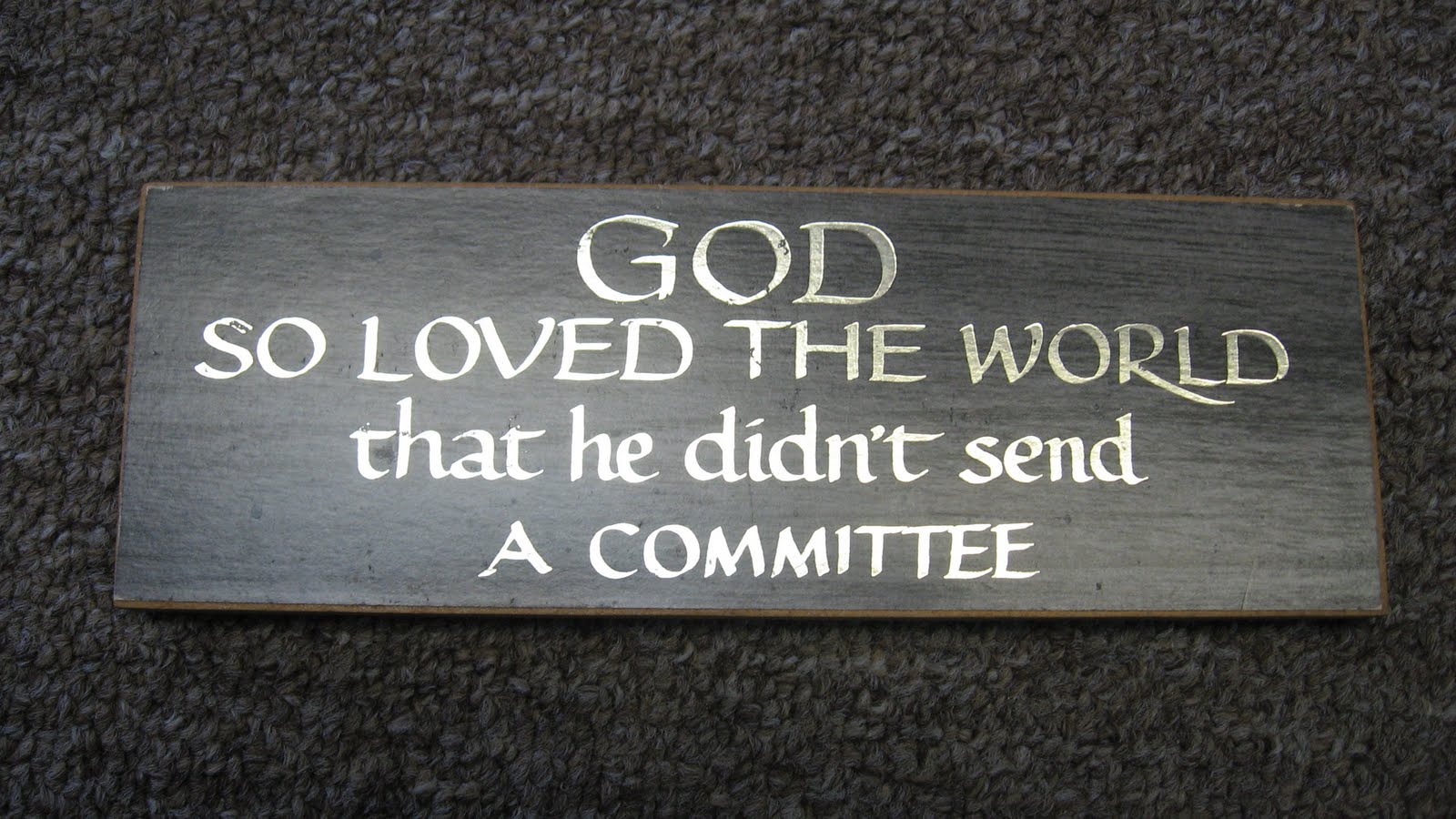
Times also change meanings: as architect of Saint Paul's Cathedral, Sir Christopher Wren was honored when Queen Anne said the finished building was awful and terrible; today she would have said awesome and overwhelming. And attempts to make words "culturally relevant" can be fraught with problems: I grew up with the King James Bible, one of the greatest works of art accomplished by a committee, but even my young ears thought it strange to hear that Pharaoh had a butler.


His "one of the greatest works of art accomplished by a committee" line prompted me to recall this plaque that hangs in my boss's office:

Monday, April 25, 2011

Surrexit Dominus Vere, Alleluia!

I think it's interesting that at Mass on Easter Sunday, in lieu of professing the Nicene Creed, each of us is cross-examined (pardon the pun) about its contents, and asked to affirm whether we believe what the Church believes.

We might ask ourselves, when we say the Creed on any other given Sunday, how much thought do we give it when we say, "On the third day He rose again in fulfillment of the Scriptures?"

Do we really believe this? Do our thoughts, words, and actions convey that we really believe this?

The Resurrection of Jesus is the central belief of our faith. It isn't just a nice story that only credulous bumpkins believe in. It is a story, yes, but it also happens to be a true story.

Because, you know, it really happened.

I had thought about writing today about how hopelessly and laughably implausible all of the alternative explanations to The Empty Tomb are, but I don't have time. That, and there are already many wiser than I who have written articles debunking the would-be debunkers, so I'll just link to one of those instead.

And I'll say this:

Christ is risen! Indeed He is Risen!

And yea, our faith is true:

If there is no resurrection of the dead, then neither has Christ been raised. And if Christ has not been raised, then empty (too) is our preaching; empty, too, your faith. Then we are also false witnesses to God, because we testified against God that he raised Christ, whom he did not raise if in fact the dead are not raised.

For if the dead are not raised, neither has Christ been raised, and if Christ has not been raised, your faith is vain; you are still in your sins.

Then those who have fallen asleep in Christ have perished. If for this life only we have hoped in Christ, we are the most pitiable people of all. But now Christ has been raised from the dead, the firstfruits of those who have fallen asleep. (1 Cor. 15: 13-20)

Thursday, April 21, 2011

"I Cannot Worship a Guy I Can Beat Up"

A while back, Mark Shea drew attention to some remarks by Pastor Mark "High Octane Calvinism" Driscoll of Seattle's Mars Hills Church:

In Revelation (the last book of the New Testament), Jesus is a prize-fighter with a tattoo down His leg, a sword in His hand and the commitment to make someone bleed. That is the guy I can worship. I cannot worship the hippie, diaper, halo Christ because I cannot worship a guy I can beat up.


Shea remarked: "I’m sure the guards in charge of the scourging at the pillar felt the same way. Surely, the measure of our worship is 'Can I beat up Jesus?'"

His comment prompted me to recall this ancient Eastern icon:


Its name? Christ the Bridegroom.

Think about that for a minute, especially in light of the Events we are preparing to commemorate tomorrow on Good Friday.

I, like most men on their wedding day, went to great lengths to look my best.

And yet, Our Lord and Savior Jesus Christ — the Bridegroom of bridegrooms — is here shown with His hands bound, stripped half naked, having just been mercilessly scourged and crowned with thorns, and as a result so weak that He can't even hold His head up straight.

Yes, Christ the Bridegroom, for He was preparing to perform the ultimate act of self-sacrificial love for His Bride the Church — read: us — just a few hours later, the completion of which He would signal by crying out from the gibbet of the Cross words we rightly associate with marriage:

"It is consummated."

Friday, March 25, 2011

It's No Coincidence That the Ring Is Destroyed on March 25

What with today's being the feast of the Annunciation, I figured it would be as good a day as any to post an excerpt from this article by the ever interesting Joseph Pearce, who explains why, despite the persistent protestations of some skeptics, The Lord of the Rings is a fundamentally religious and Catholic work — which, I suppose, is a bit like shooting fish in a barrel, since Tolkien himself said LotR is, you know, "a fundamentally religious and Catholic work."

If, however, Christ is never mentioned by name in The Lord of the Rings, how can we discern his invisible presence?

The most obvious parallel between Tolkien's myth and the Christian truth it reflects so faithfully is in the nature of the quest which constitutes the principal animus of Tolkien's story. The journey of Frodo and Sam into the very heart of Mordor in order to destroy, or unmake, the Ring in the fires of Mt. Doom is emblematic of the Christian's imitation of Christ in carrying the cross of sin.

At its most profound level, The Lord of the Rings is a sublimely mystical passion play. The carrying of the ring — the emblem of sin — is the carrying of the cross. This is the ultimate applicability of The Lord of the Rings — that we have to lose our life in order to gain it; that unless we die we cannot live; that we must all take up our cross and follow him.

All of this would be deducible from the story itself but Tolkien makes the parallel even more explicit. "I should say," he wrote, explaining the final climactic moments on Mt. Doom, "that within the mode of the story [it] exemplifies (an aspect of) the familiar words: 'Forgive us our trespasses as we forgive them that trespass against us. Lead us not into temptation but deliver us from evil.'"

As if this were not enough to silence those skeptics who obstinately refuse to acknowledge the overriding Christian dimension in The Lord of the Rings, Tolkien makes it even more unmistakable, and unavoidable, in the fact that the climactic attempt to destroy the ring, and in consequence the Dark Lord who had forged it, occurred on "the twenty-fifth of March."

The significance of this date will not escape the attention of Catholic scholars, though it is certainly overlooked all too often by Tolkien's non-Christian admirers. Tom Shippey, an Anglo-Saxon scholar and Tolkien expert, states in his book, The Road to Middle Earth, that in "Anglo-Saxon belief, and in European popular tradition both before and after that, March 25 is the date of the Crucifixion." It is also, of course, the Feast of the Annunciation, the celebration of the absolute center of all history as the moment when God himself became incarnate as man.

A Catholic and an Oxford don, Tolkien was well aware of the significance of "the twenty-fifth of March." It signified the way in which God had "unmade" the Fall, which, like the Ring, had brought humanity under the sway of "the Shadow." If the ring that the hero wants "unmade" at the culmination of Tolkien's quest is the "one ring to rule them all, and in the darkness bind them," the Fall was the "one sin to rule them all, and in the darkness bind them." On March 25, the one sin, like the one ring, had been "unmade," destroying the power of the Dark Lord.

Monday, February 28, 2011

Monday, December 13, 2010

What Have I Done Lately?

Today, the Church celebrates the feast of St. Lucy, patron saint of — among others — the blind.

While looking at the calendar a few days ago and taking note of this feast day, I was prompted to recall an encounter I had ten years ago.

After graduating college, I got a job teaching Religion at Good Counsel High School, a girls’ school on the Northwest Side of Chicago run by the Felicians Sisters.

After one of the teacher in-services at the beginning of the school year, Sister Mary Justilla Podgorski, who ran the attendance office, invited me to visit the Felicians’ Chicago Province Motherhouse (where she lived) next door to the school, where she introduced me to many of the other sisters in her community.

One of the sisters I met that day — whose name, I regret, escapes me — had been blind for ten years. After Sister Justilla and I talked to her for a few minutes (and listened to her play a song on her electric piano), we moved on. Sister Justilla then whispered to me that this sister offers up all of her suffering related to her blindness for those addicted to pornography.

I remember thinking at that moment that I felt like The Great Slacker of the World.

I’ve just met a saintly woman who hasn’t been able to see for ten years, and all this time she’s been offering up to God all of the pain, frustration, and suffering her blindness has caused her on behalf of porn addicts. And what have I done lately?

Penance and mortification are key aspects to a healthy spiritual life. And so it’s important for us to consider from time to time, especially during this penitential season of Advent: What have I offered up lately for my family? My friends? My co-workers? The guy down the street who’s out of work? The woman on the Hooters billboard I saw on the way to work this morning?

Etc.

What have I done lately?

[Cross-posted at Catholic Dads]

Wednesday, December 8, 2010

"Without Stain"

In honor of today's solemnity, it never hurts to remind ourselves what Holy Mother Church teaches (and what she does not teach) about the Immaculate Conception:

It’s important to understand what the doctrine of the Immaculate Conception is and what it is not. Some people think the term refers to Christ’s conception in Mary’s womb without the intervention of a human father; but that is the Virgin Birth. Others think the Immaculate Conception means Mary was conceived "by the power of the Holy Spirit," in the way Jesus was, but that, too, is incorrect. The Immaculate Conception means that Mary, whose conception was brought about the normal way, was conceived without original sin or its stain—that’s what "immaculate" means: without stain.


It's interesting to note that the Church places greater importance on this day, when she commemorates the conception of Mary in the womb of St. Anne, than on the day she commemorates Mary's birth — celebrated, appropriately enough, nine months from today, on September 8.

In honor of the celebration of Our Lady's Immaculate Conception, I've included below what is, in my opinion, the most cogent paragraph ever written on Marian devotion.

It's from The Everlasting Man, my favorite work of G. K. Chesterton.

Given that we're in the midst of Advent, it's also rather timely:

If the world wanted what is called a non-controversial aspect of Christianity, it would probably select Christmas. Yet it is obviously bound up with what is supposed to be a controversial aspect (I could never at any stage of my opinions imagine why); the respect paid to the Blessed Virgin. When I was a boy a more Puritan generation objected to a statue upon my parish church representing the Virgin and Child. After much controversy, they compromised by taking away the Child. One would think that this was even more corrupted with Mariolatry, unless the mother was counted less dangerous when deprived of a sort of weapon. But the practical difficulty is also a parable. You cannot chip away the statue of a mother from all round that of a newborn child. You cannot suspend the new-born child in mid-air; indeed you cannot really have a statue of a newborn child at all. Similarly, you cannot suspend the idea of a newborn child in the void or think of him without thinking of his mother. You cannot visit the child without visiting the mother; you cannot in common human life approach the child except through the mother. If we are to think of Christ in this aspect at all, the other idea follows as it is followed in history. We must either leave Christ out of Christmas, or Christmas out of Christ, or we must admit, if only as we admit it in an old picture, that those holy heads are too near together for the haloes not to mingle and cross.

Wednesday, December 1, 2010

"Campion, the Seditious Jesuit"

"In condemning us, you condemn all your own ancestors, all our ancient bishops and kings, all that was once the glory of England -- the island of saints, and the most devoted child of the See of Peter."


Thus spake St. Edmund Campion upon being sentenced to death as a traitor.

He was hanged, drawn, and quartered on this day in 1581.

Apropos of this, I can't help but call to mind a quip by Oscar Wilde (whose death — and, far more importantly, deathbed conversion to Catholicism — 110 years ago) was commemorated yesterday.

The Catholic Church, Wilde remarked, is "for saints and sinners alone — for respectable people, the Anglican Church will do."

St. Edmund Campion, ora pro nobis.

Wednesday, November 24, 2010

Gratitude

What with tomorrow being Thanksgiving, I decided last week on a rather unoriginal idea: to write a list of things I'm thankful for.

That said, I am thankful for:

1. Teresa, our almost 8-year old daughter, who told me a couple weeks ago, “Daddy, today I learned the difference between perfect and imperfect contrition” – and then proceeded to explain said difference in a way that would surely have satisfied even St. Thomas Aquinas.

2. Cecilia, our 6-year old daughter, who already has way, way more artistic talent than I have, allowing her to create neat pictures like this:


3. Lucy, our 5-year old daughter, who loves to sing along as loudly as she possibly can to the soundtrack of Annie.

4. Joe, our 3-year old son, who always seems happy and who seems to make everybody else he sees happy too.

5. Anthony/A.J., our 19-month old son, whose willingness to climb most anything causes me to think he’s destined for many fearless pursuits throughout life.

6. That all of our children’s godparents are exemplary role models who pray for them every day.

7. Our new baby, due in April.

8. That all of us are in relatively good health.

9. Jocelyn, who is, well, just an awesome wife.

10. Jocelyn, who is, well, just an awesome mom.

11. A job I absolutely love.

12. A modest home in a decent neighborhood.

13. Two motorcars that are paid for, one of which, given to us by one of my brothers 10 years ago, still runs just fine.

14. The speech therapists I met with (after being picked up by the short bus) a few times a week from kindergarten through second grade who helped me overcome a significant stuttering habit.

15. The many great teachers I’ve had throughout my life.

16. The time I spent teaching from 2000-2004.

17. A family and extended family (on both my side and Jocelyn’s) in which – more or less – everybody gets along.

18. Chicago-style pizza.

19. The writings of G.K. Chesterton.

20. Countless good friends.

21. Loving and supportive parents.

22. Having had the chance to study in Rome for four months in 1997.

23. Having grown up in a home in which neither money nor food was wasted, which very much helped me to learn the proverbial “value of a dollar.”

24. Having grown up in Minnesota, as a result of which I know that the proper way to play the game is “Duck, Duck, Gray Duck” – not the silly, ridiculous apology known as “Duck, Duck, Goose”.

25. Our local parish – St. Odilo – a mere four blocks from our house, where the Tridentine Mass is offered every Sunday.

26. St. John Cantius, our “other” parish – where, on any given Sunday, three or four priests hear confessions before (and during) Mass, so that wretched, habitual sinners like me are able, as often as we need, to bare our souls to someone who really and truly does have the power to forgive them.

27. Far more than I could possibly hope to include in a list like this.