Showing posts with label History. Show all posts

Thursday, August 14, 2014

St. Maximilian Kolbe, Martyr

Many people are at least somewhat familiar with the saint whose feast day the Catholic Church celebrates today — namely, St. Maximilian Kolbe, who voluntarily gave up his life in Auschwitz in 1941 to spare the life of one Franciszek Gajowniczek.

But what is lesser known is that during the canonization process, a controversy arose in the Church as to whether or not Father Kolbe should be regarded as a martyr.

George Weigel writes in Witness to Hope:

The Pope [John Paul II] has regularly reminded the world that the twentieth century is the greatest century of martyrdom – faithful witness unto death – in Christian history. And no martyr of the twentieth century has been, for John Paul, a more luminous icon of the call to holiness through radical, self-giving love than Maximilian Kolbe. Kolbe was the "saint of the abyss" – the man who looked straight into the modern heart of darkness and remained faithful to Christ by sacrificing his life for another in the Auschwitz starvation bunker while helping his cellmates die with dignity and hope.

Kolbe’s canonization was set for St. Peter’s Square on Sunday, October 10, 1982. But a question had arisen. Father Kolbe was widely regarded as a martyr, but was he a "martyr" in the technical sense of the term – someone who had died because of odium fidei, "hatred of the faith"? He had not been arrested because of odium fidei, and witnesses to his self-sacrifice had testified that the Auschwitz commandant, Fritsch, had simply accepted Kolbe’s self-substitution for the condemned Franciszek Gajowniczek without evincing any particular satisfaction that he was killing a priest. The theologians and experts of the Congregation for the Causes of Saints… had argued that Kolbe, while undoubtedly a saint, was not a martyr in the traditional sense of the term. At Kolbe’s beatification in 1971, Pope Paul VI had said that Kolbe could be considered a "martyr of charity," but this was a personal gesture and the category lacked standing in theology or canon law. Since then, though, the Polish and German bishops had petitioned the Holy See that Kolbe be canonized as a martyr, rather than as a saintly confessor who happened to have died under extraordinary circumstances.

John Paul II appointed two special judges to consider the question from the theological and historical points of view. Their reports were then submitted to a special advisory commission. The majority of the commission concluded that Blessed Maximilian Kolbe’s self-sacrifice did not satisfy the traditional criteria for martyrdom, heroic as it undoubtedly was. On the day of his canonization, it was unclear whether Kolbe would be given the accolade of a martyr, as many Poles, Germans, and others wished.

On October 10, 1982, a magnificent autumn morning, found a quarter of a million people in St. Peter’s Square, where they saw a great banner, a portrait of Father Kolbe, draped from the central loggia. Still, the question hung in the air: Would Kolbe be recognized as a martyr? The answer came when John Paul II processed out of the basilica and into the square wearing red vestments, the liturgical color of martyrs. He had overridden the counsel of his advisory commission, and in his homily he declared that "in virtue of my apostolic authority, I have decreed that Maximilian Mary Kolbe, who following his beatification was venerated as a confessor, will henceforth be venerated also as a martyr!"

A pope overriding the advice of his advisory commission...shades of Pope Paul VI, methinks.

To those outside the Church — or, for that matter, even many of those within the Church — the question of whether St. Maximilian Kolbe should be regarded as a martyr may seem trivial.

But Weigel goes on to explain why it's so crucial:

John Paul II was making an important theological point in deciding that St. Maximilian Kolbe was indeed a martyr – systematic hatred for the human person (systematic odium hominis, so to speak) was a contemporary equivalent of the traditional criterion for martyrdom, odium fidei. Because Christian faith affirmed the truth about the inalienable dignity of the human person, anyone who hated that truth hated, implicitly, the Christian faith. Modern totalitarianism was an implicit form of odium fidei, because it reduced persons to things.

St. Maximilian Kolbe is the patron saint of drug addicts, political prisoners, families, journalists, prisoners, and the pro-life movement.

St. Maximilian Kolbe, pray for us!

Thursday, December 22, 2011

Thursday, May 5, 2011

"Priests Were Not Welcomed by the Nazis"

In yesterday's Chicago Tribune, accompanying a story about Derrick Rose being named the NBA's MVP at age 22 is a feature titled, "Where were you at 22?" that looks at what Some Famous People were doing at that age.

Notice in particular the caption next to Pope John Paul II:


I guess you could say that "priests were not welcomed by the Nazis," but that's a bit of an understatement, don't you think?

Monday, April 25, 2011

Surrexit Dominus Vere, Alleluia!

I think it's interesting that at Mass on Easter Sunday, in lieu of professing the Nicene Creed, each of us is cross-examined (pardon the pun) about its contents, and asked to affirm whether we believe what the Church believes.

We might ask ourselves, when we say the Creed on any other given Sunday, how much thought do we give it when we say, "On the third day He rose again in fulfillment of the Scriptures?"

Do we really believe this? Do our thoughts, words, and actions convey that we really believe this?

The Resurrection of Jesus is the central belief of our faith. It isn't just a nice story that only credulous bumpkins believe in. It is a story, yes, but it also happens to be a true story.

Because, you know, it really happened.

I had thought about writing today about how hopelessly and laughably implausible all of the alternative explanations to The Empty Tomb are, but I don't have time. That, and there are already many wiser than I who have written articles debunking the would-be debunkers, so I'll just link to one of those instead.

And I'll say this:

Christ is risen! Indeed He is Risen!

And yea, our faith is true:

If there is no resurrection of the dead, then neither has Christ been raised. And if Christ has not been raised, then empty (too) is our preaching; empty, too, your faith. Then we are also false witnesses to God, because we testified against God that he raised Christ, whom he did not raise if in fact the dead are not raised.

For if the dead are not raised, neither has Christ been raised, and if Christ has not been raised, your faith is vain; you are still in your sins.

Then those who have fallen asleep in Christ have perished. If for this life only we have hoped in Christ, we are the most pitiable people of all. But now Christ has been raised from the dead, the firstfruits of those who have fallen asleep. (1 Cor. 15: 13-20)

Tuesday, October 12, 2010

I'm Glad

...that our kids have Jocelyn's knack for crafting:

Wednesday, August 18, 2010

Some All Too Often Ignored Points about Church History

...from Mark Shea:

What simple-minded believers in this simple minded “Evil Empire Clerics vs. Plucky Rebel Alliance Laity” myth never seem to understand is that it was just as often the laity who were eagerly tanking up on the Blood Libel and chucking Jews down wells for the supposed crime of drinking the blood of Christian children while it was the clerics who were telling everybody to cool off and stop believing urban legends.


So, for instance, the simple tale of slavery turns out to be fraught with complexity, not least because it was not all laypeople opposing it (lots of laity got stinking rich off it) and it was not all clerics supporting it.  Slavery, it turns out, was an immemorial institution throughout all of human civilization and the way in which the Church engaged it simply cannot be boiled down to laity good/cleric bad.  Lots and lots and lots of laity had as little patience for the Church’s nuanced arguments for the dignity of the slave as readers like the one above have for the Church’s nuanced arguments for the distinction between the dignity of the homosexual person and the sin of homosexual intercourse.


Indeed, one of the ironies of the Church’s history is that, for most of it, the main charge brought against the Church is not that it is too conservative, but that it is too liberal.  It is the laity that, again and again, rushes off all agog for some form of extremist rigorism.  Had the Church listened to the “opinions and wisdom of the rest of the body of Christ” during the Donatist enthusiasm, we would have excommunicated large portions of the Body of Christ because they did not measure up to the hyper-rigorism of the Donatists, who held that any priest who did not measure up under persecution could not validly consecrate the Eucharist and any bishop who did not measure up could not validly ordain.  We would have caved in to Lollards who insisted that anybody not in a state of grace could not function as an agent of the state and need not be obeyed by citizens of that state.  Asking whether the cop who is arresting a mugger is in a state of grace may seem spiritual to some of our more ethereal members of the Body of Christ, but for most of us it is, as Chesterton noted, “wanting in actuality.”  Most Catholic heresies down through the ages have been attempts to keep as many people away from the grace of God as possible, urging the faithful to stay away from the Eucharist, shut up, and give up the hope of salvation.  The “wisdom” of the first antipope in history was that the Pope was a wuss who welcomed people back to communion far too easily, when what they needed was merciless rejection by the pure.


Indeed, the reason for the Church’s creation of a system of Inquisitions was precisely that laypeople were, in their profound wisdom that needed no guidance from celibate old men, already running around doing it on their own as vigilantes and lynch mobs.  Turns out the Church thought that having a system whereby the facts were obtained and evaluated in an orderly way was better than something like this.


Of course, most people get their history from Monty Python and therefore could not tell you five intelligent words from a primary source about what actually took place in an Inquisition (and yeah, there were more than one and they weren’t all in Spain).  Similarly, most people don’t seem to know that though God does indeed sometimes raise up “ordinary pwople to challenge the istitutional church of the time”, He also raises up clergy to challenge the easy assumptions of fat, dumb, and happy ordinary people, who are quite certain that, whatever Gregory X says, Jews are drinking the blood of Christian children; or that whatever out-of-touch Dominicans may say, Indians are natural slaves; or that whatever pantywaists like the pope and bishops say, the nuclear murder of thousands of Japanese or the torture of prisoners in the War on Terror is the glorious work of God; or that whatever the Church says about the value of human life, abortion is a beautiful right and the sole core value of the Democratic party.  Looking around at our violent, selfish and sex-besotted culture, I’m not immediately persuaded that we glorious laity are a civilization of St. Catherines who are prevented from flourishing in sanctity by the evil machinations of Benedict XVI.  This optimistic self-assessment, while quite in keeping with the enormously high self-regard of the Baby Boomers, fails to premise itself on much resembling “reality”.  One forms, rather, the impression that Benedict is a thoughtful, gentle, and holy man who is doing his best to speak the Church’s beautiful teaching to a braying horde of crazies compact of talk radio lackeys, cokeheads, horndogs, warmongers, sex maniacs and addicts of therapeutic moralistic deism who let Oprah or FoxNews do all their thinking for them.  That he maintains his gentle and thoughtful composure in the midst of such a TV-addled culture with the attention span of fruit flies is astounding to me.


Read the whole thing.

Friday, June 4, 2010

The Catholic Church Persecuted Copernicus, Doncha Know

Oh. Wait.

Now, a smart reporter would note that getting buried under a cathedral is not exactly regarded as a sign of heresy or dishonor in medieval Poland. But an MSM reporter just regurgitates a Dan Brownian meme without thinking about it too much.


And speaking of Church history fails [HT: Theology Fail Blog]:

Tuesday, May 25, 2010

"Clarity on Torture"

Sean Dailey has an editorial currently up on the website of Gilbert Magazine that's titled, appropriately enough, "Clarity on Torture".

Here's an excerpt:

Do we really need to get into the nuts and bolts of what constitutes torture?

Yes, we do. Most will agree that taking a power drill to a man’s shoulder or pulling out his fingernails with pliers for punishment or to extract information is torture. But when the subject is waterboarding, clarity vanishes again. Some consider waterboarding to be mere psychological torture — which, as we’ve already established, is morally indistinguishable from physical torture.

But waterboarding is not a harmless dunk in the tub, as former Vice President Dick Cheney once likened it, and it is not psychological torture. In waterboarding, a subject is strapped to a gurney. His feet are elevated slightly above his head. A cloth is draped over his face. And water is poured on his face so that it enters his nose and mouth and flows into his lungs. CIA interrogators are instructed to pour the water immediately after a detainee exhales, to ensure he inhales water, not air. They use their hands to “dam the flow” of excess water from a detainee’s mouth. And detainees who are scheduled for waterboarding are put on a liquid diet, to minimize the risk of death should they inhale their own vomit.

This procedure became official American policy in our so-called War on Terror, but it was not always so. Waterboarding has been condemned by the United States government since at least 1898, when American soldiers were court marshaled for waterboarding prisoners during our occupation of the Philippines following the Spanish-American War. In World War II, we hanged Japanese war criminals for waterboarding American and Allied troops. In the 1980s in Texas, a sheriff and three of his deputies were convicted by the Justice Department for waterboarding prisoners to extract confessions.

And yet, there are those exceptions: American security is at stake. If waterboarding saves even one life, isn’t it worth it?

If torturing a terrorist suspect saved a city from destruction, or if it saved even one life, it would still be a barbaric, savage act, unworthy of a civilized society. If expediency were enough to justify an immoral act, then abortion would be justifiable.


Read the whole thing.

Tuesday, May 11, 2010

An Interesting Take

Among the various retrospectives I've come across in recent days marking the Pill's introduction 50 years ago this month, probably the most unique I've seen thus far is a First Things piece titled "Beyond the Pill: Looking for the Origins of the Sexual Revolution" from military historian Stuart Koehl.

Therein he offers some observations that are sure to prompt some garment-renting and teeth-gnashing among those who go in for the notion that The 40s And 50s Were Great But The 60s Ruined Everything:

Because of its scope and intensity, World War II shattered an existing moral consensus, creating a socially unstable situation in which “ordinary” morality was jettisoned. People lived very intensely and with the knowledge that everything, including life itself, was transient. The typical American serviceman in World War II had four sex partners, not counting prostitutes. Venereal disease rates for U.S. servicemen in Europe and Australia reached epidemic proportions that eventually required the military to license and regulate brothels. As Kipling wrote, “Single men in barracks don’t grow into plaster saints”.

While soldiers were fornicating their way across Europe and women on the home front were in contact with men on the war assembly lines, the number of “Dear John” letters received at the front and in the POW cages constituted a real threat to morale. One received in 1944 by a POW in Stalag Luft VII read: “Dear John, I hope you are open-minded, because I just had a baby. His father is a wonderful guy, and he has enclosed some cigars for you”. Of course, most men and women were not promiscuous during the war—just as most men and women today are not—but enough were to have a lasting impact.

After the war, everything was supposed to return to normal, but of course, it did not, and many trends conspired to ensure that they would not, including unprecedented prosperity, social and physical mobility—which broke down traditional ties of family and community, a burning resentment of authority among servicemen and a more relaxed attitude toward sex, growing out of the wartime experience.

For a generation that grew up in uniform, hypocrisy was not seen as something necessary for the smooth running of society. If the boomers grew up rebels, it’s because their parents encouraged rebellion even while outwardly conforming to social norms themselves. Everybody liked sex, and many broke sexual barriers, though still exercising discretion and obedience to form. But, looking at the divorce rates between the late forties to the mid-sixties, one can already see the incipient breakdown of marriage owing, in part, to hasty wartime marriages combined with the stress of servicemen reintegrating into civilian society. ... One prominent feature of many marriages then was the pressure on men to marry women whom they impregnated, resulting in shotgun weddings and “premature” births. Fortunately, it was at a time when a man just out of high school could get a high-paying, semi-skilled job with union protection. It would be safe to wager, though, that many of those marriages collapsed once their children were grown.

Many of the behaviors predisposed by the pill were already common, albeit covert, features of American life once the pill became available. The pill added fuel to a smoldering fire; it didn't start the blaze, but it certainly accelerated it and ensured its spread. The greatest damage done by the pill has been to women. It shifted the onus for avoiding pregnancy to women, absolving men of responsibility for unwanted pregnancies, which, in essence, made sex into a casual activity. Men no longer had to marry the women they impregnated, which, in turn, made legalized abortion inevitable, again leaving women to bear the psychological and moral consequences. So as we mark the anniversary of the pill, we should spend more time trying to understand the social forces that caused us to react to the pill as we did, allowing us to discard a long-standing moral consensus, leaving only sexual chaos and uncertainty.

Friday, April 9, 2010

Only Three More Days

Until outdoor baseball returns to Minnesota.

Being 400 miles away, I'm not sure when I'll see the new stadium in person, but I'm glad to see the old logo -- which they never should have gotten rid of -- figures prominently therein:


For them that don't know, here's the backstory on the logo:

The name "Twins" was derived from the popular name of the region, the Twin Cities. The NBA's Minneapolis Lakers had re-located to Los Angeles in 1960 due to poor attendance which was believed to have been caused in part by the reluctance of fans in St. Paul to support the team. [Team owner Calvin] Griffith was determined not to alienate fans in either city by naming the team after one city or the other, so the team became known as the Minnesota Twins. However, the original "Twin Cities Twins" TC logo was kept, and the team logo showed two men, one in a Minneapolis Millers uniform and one in a St. Paul Saints uniform, shaking hands across the Mississippi River. This remained the team's primary logo until 1987, when the team felt it was established enough to put an "M" on its cap without having St. Paul fans think it stood for Minneapolis.


And here's the backstory's backstory on the bitter, longstanding Millers-Saints rivalry:

“EVEN DURING THE DEPRESSION we could always count on a good crowd when the Saints and Millers played each other," recalled Oscar Roettger, a pitcher and first baseman for St. Paul during the 1920s and 1930s. "Pay days - that's what those games were."

The diamond rivalry between Minneapolis and St. Paul was in its golden years during Roettger's playing days, but its roots were part of the post-Civil War baseball boom in America. Minnesota veterans returning home from Bull Run, Shiloh and Gettysburg began waging their own War Between the Cities, a battle fought with less lethal weapons - bats and balls - but one that lacked a cease-fire for nearly a hundred years.

From the town teams of the 1860s and 1870s, the professional nines of the latter 1800s and finally the great Saints and Millers clubs of the twentieth century, they fought - player vs. player, fan vs. fan, sometimes player vs. fan.

The newspapers even fired their artillery at enemy camps across the river. In the 1890s, when both cities were represented in the Western League, the Minneapolis Tribune leveled a charge of "dirty ball" against its neighbors to the east, then owned and managed by Charles Comiskey. "Manager Comiskey," reported the Tribune, "will be served with a formal notice that the Minneapolis club will not play today's game unless guaranteed that there will be no spiking of Minneapolis players, no interference on the part of the crowd, no throwing of rocks, no throwing of dust and dirt in the eyes of the Minneapolis players, and a few other tricks which the game yesterday was featurized by."


Read the whole thing.

Monday, April 5, 2010

Surrexit Dominus Vere!

It's interesting, I think, that on the first day of Easter, in lieu of professing the Nicene Creed, each of us is cross-examined (pardon the pun) about its contents, and we are asked to affirm whether we believe what the Church believes.

We might ask ourselves, when we say the Creed on any other given Sunday, how much thought do we give it when we say, "On the third day He rose again in fulfillment of the Scriptures?"

Do we really believe this? Do our thoughts, words, and actions convey that we really believe this?

The Resurrection of Jesus is the central belief of our faith. It isn't just a nice story that only credulous bumpkins believe in. It is a story, yes, but it also happens to be a true story.

Because, you know, it really happened.

I had planned to write today about how hopelessly and laughably implausible all of the alternative explanations to The Empty Tomb are, but I don't have time. That, and there are already many wiser than I who have written articles debunking the would-be debunkers, so I'll just link to one of those instead.

And I'll say this:

Christ is risen! Indeed He is Risen!

And yea, our faith is true:

If there is no resurrection of the dead, then neither has Christ been raised. And if Christ has not been raised, then empty (too) is our preaching; empty, too, your faith. Then we are also false witnesses to God, because we testified against God that he raised Christ, whom he did not raise if in fact the dead are not raised.

For if the dead are not raised, neither has Christ been raised, and if Christ has not been raised, your faith is vain; you are still in your sins.

Then those who have fallen asleep in Christ have perished. If for this life only we have hoped in Christ, we are the most pitiable people of all. But now Christ has been raised from the dead, the firstfruits of those who have fallen asleep. (1 Cor. 15: 13-20)

Friday, March 26, 2010

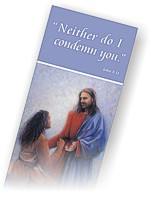
"Neither Do I Condemn You"

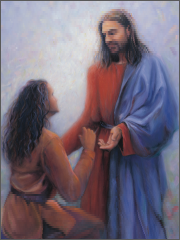
At Mass this past Sunday, we heard the story of the woman caught in adultery (John 8:1-11).

One thing I find amazing about this passage is that it almost didn't make it into the Bible. In fact, before the canon of Scripture was finalized in the late 4th century, some versions of John's Gospel didn't include this story.

St. Augustine tells us (cf. De coniugiis adulterinis, 2, 6) that many early Christians were afraid of keeping this story in John's Gospel since it showed Jesus as being so merciful that they thought it might lead people to think that the reality of sin wasn't as big of a deal as the Church made it out to be.

Apparently, the Holy Spirit wasn't concerned about this, since He made sure the story was kept in there.

Related


Mark Shea's take on this story in his recent article on The Sixth Commandment is well worth a read. Check thou it out.

Wednesday, March 24, 2010

The 30th Anniversary of the Murder of Archbishop Oscar Romero

On this day in 1980, Archbishop Oscar Romero was assassinated while celebrating Mass in San Salvador, El Salvador.

I've had a special admiration for Archbishop Romero ever since I first saw the eponymous film about his life (and death). My admiration for him grew significantly when Jocelyn and I visited his tomb and the chapel where he was murdered during a trip to El Salvador 10 years ago.

When questioned about Romero by Italian journalists 3 years ago prior to his trip to South America, I was heartened to learn that Pope Benedict XVI remarked, "I have no doubt he will be beatified."

Here's the trailer for the movie:


As you can tell, this is no feel-good movie, but as far as showing the ugly reality of man’s inhumanity to man, and the insane brutality that so typified life in Central America in the last quarter of the last century, it’s amazing.

The closing scene, and a few others, too, are absolutely stunning — all the more so because despite some artistic license, the movie is depicting events that really happened.

Tuesday, January 19, 2010

Slandering Pope Pius XII

There is perhaps no historical canard for which I have less patience than the charge that Pope Pius XII was a feckless coward who "didn't do enough" to help Jews during the Holocaust.

There is no shortage of well-documented defenses of Pius, and if you've never read anything on this subject before, this article by Professor Ronald Rychlak is surely a good start.

Tuesday, October 20, 2009

Everything You Know about the Catholic Church, Science, and the Middle Ages Is Wrong

Mark Shea introduces this post, titled "The Age of Unreason", thusly:

Mike Flynn is like a walking encyclopedia of arcana about medieval science and philosophy. Yesterday, I read aloud to my wife and son most of his reply to some dude who was emitting the normal credal agitprop about the Dark Ages and Christian hatred of science and reason. If it had been a boxing match, the ref would have stopped the fight. You come away, not just laughing, but shsking your head thinking, "Poor Mr. Walker really deeply believes in his own intellectual superiority. Yet... how? What conceivable reason can he have, if he read Flynn's evisceration of his astoundingly ill-argued regurgitation of Atheist Triumphalist Talking Points, to feel anything but humiliation, embarrassment, and a driving urge to remove that wretched excuse for an essay from the web and recant in sackcloth and ashes for the sin of just pure ignorant wrong dumbness and arrogance?

My 14 year old is taking a writing class. He asked, "Why do I need to know how to argue about stuff?" I tell him, so you won't serve as a warning to others like Mr. Walker here. The man's gutted corpse is hanging from a tree branch and he's still talking as though he is Way Smarter Than You. You don't want to look a fool like that.


Thou wouldst do well to read it.

I must admit that I laughed out loud when I read that Flynn characterized Giordano Bruno as "the L. Ron Hubbard of his day". I also had to chuckle at one of the comments posted by someone else:

You didn't mention St. Macrina and automata.

I love St. Macrina. As she was on her deathbed, she cheered up her little brother, St. Gregory of Nyssa, by holding a Socratic dialogue with him. He later recorded this as "On the Soul and the Resurrection", as well as in The Life of St. Macrina.

Anyway, in the middle of all this, St. Greg points to how atheists of his day said automata proved there wasn't God or a soul, and St. Mac went into how automata indicated there was. Awesome moment in girl geek history.

Monday, August 10, 2009

Monday, May 11, 2009

This *So* Does Not Fit with the Narrative That the Medieval Catholic Church Was Anti-Science

Because that narrative isn't, um, true.

The first known serious flight attempt in world history occurred about a thousand years before the Wright brothers, in western England. Then, a young Benedictine monk leapt with a crude pair of cloth wings from a watchtower of a church abbey at the beginning of the 11th century. This monk, known to history as Eilmer of Malmesbury, covered a furlong – a distance of approximately 600 feet – before landing heavily and breaking both legs. Afterwards, he remarked that the cause of his crash was that he had forgotten to provide himself with a tail.

We know of Eilmer’s attempt through the writings of a historian, William of Malmesbury, who mentions the flight in passing. Of more interest to William was that Eilmer, late in his life, was the first person to spot a comet, which people then credited as being an omen of the Norman invasion of England by William the Conqueror.

Eilmer typified the inquisitive spirit of medieval enthusiasts who developed small drawstring toy helicopters, windmills, and sophisticated sails for boats. ...

Given the geography of the Abbey, his landing site, and the account of his flight, he must have remained airborne about 15 seconds. At low altitude he apparently attempted to flap the wings, which threw him out of control. His post-flight assessment qualifies him as the first test pilot, for he sought to understand, in technological terms, what happened on the flight and why he crashed.


Read the whole thing.

[HT: Sean Dailey via Fr. Z. via Daniel Matsui]

Thursday, April 9, 2009

"Ecce Homo"

As we prepare over the next few days to commemorate the events that comprise the pivot on which everything else turns, I've included herein a reflection on Our Lord Jesus Christ's final hours from G.K. Chesterton's The Everlasting Man — the book that helped to make a Christian out of a young atheist named C. S. Lewis.

As we enter into the Triduum, this excerpt from a chapter titled "The Strangest Story in the World" reminds us of the significance of the events we prepare to recall:

When Jesus was brought before the judgement-seat of Pontius Pilate, he did not vanish. It was the crisis and the goal; it was the hour and the power of darkness. It was the supremely supernatural act, of all his miraculous life, that he did not vanish.

Every attempt to amplify that story has diminished it. The task has been attempted by many men of real genius and eloquence as well as by only too many vulgar sentimentalists and self-conscious rhetoricians. The tale has been retold with patronising pathos by elegant sceptics and with fluent enthusiasm by boisterous best-sellers. It will not be retold here. The grinding power of the plain words of the Gospel story is like the power of mill-stones; and those who can read them simply enough will feel as if rocks had been rolled upon them. Criticism is only words about words; and of what use are words about such words as these? What is the use of word-painting about the dark garden filled suddenly with torchlight and furious faces? 'Are you come out with swords and staves as against a robber? All day I sat in your temple teaching, and you took me not.' Can anything be added to the massive and gathered restraint of that irony; like a great wave lifted to the sky and refusing to fall? 'Daughters of Jerusalem, weep not for me but weep for yourselves and for your children.'

As the High Priest asked what further need he had of witnesses, we might well ask what further need we have of words. Peter in a panic repudiated him: 'and immediately the cock crew; and Jesus looked upon Peter, and Peter went out and wept bitterly.' Has anyone any further remarks to offer? Just before the murder he prayed for all the murderous race of men, saying, 'They know not what they do'; is there anything to say to that, except that we know as little what we say? Is there any need to repeat and spin out the story of how the tragedy trailed up the Via Dolorosa and how they threw him in haphazard with two thieves in one of the ordinary batches of execution; and how in all that horror and howling wilderness of desertion one voice spoke in homage, a startling voice from the very last place where it was looked for, the gibbet of the criminal; and he said to that nameless ruffian, 'This night shalt thou be with me in Paradise'? Is there anything to put after that but a full stop? Or is anyone prepared to answer adequately that farewell gesture to all flesh which created for his Mother a new Son?

It is more within my powers, and here more immediately to my purpose, to point out that in that scene were symbolically gathered all the human forces that have been vaguely sketched in this story. As kings and philosophers and the popular element had been symbolically present at his birth, so they were more practically concerned in his death; and with that we come face to face with the essential fact to be realised. All the great groups that stood about the Cross represent in one way or another the great historical truth of the time; that the world could not save itself. Man could do no more. Rome and Jerusalem and Athens and everything else were going down like a sea turned into a slow cataract. Externally indeed the ancient world was still at its strongest; it is always at that moment that the inmost weakness begins. But in order to understand that weakness we must repeat what has been said more than once; that it was not the weakness of a thing originally weak. It was emphatically the strength of the world that was turned to weakness and the wisdom of the world that was turned to folly.

In this story of Good Friday it is the best things in the world that are at their worst. That is what really shows us the world at its worst. It was, for instance, the priests of a true monotheism and the soldiers of an international civilisation. Rome, the legend, founded upon fallen Troy and triumphant over fallen Carthage, had stood for a heroism which was the nearest that any pagan ever came to chivalry. Rome had defended the household gods and the human decencies against the ogres of Africa and the hermaphrodite monstrosities of Greece. But in the lightning flash of this incident, we see great Rome, the imperial republic, going downward under her Lucretian doom. Scepticism has eaten away even the confident sanity of the conquerors of the world. He who is enthroned to say what is justice can only ask: 'What is truth?' So in that drama which decided the whole fate of antiquity, one of the central figures is fixed in what seems the reverse of his true role. Rome was almost another name for responsibility. Yet he stands for ever as a sort of rocking statue of the irresponsible. Man could do no more. Even the practical had become the impracticable. Standing between the pillars of his own judgement-seat, a Roman had washed his hands of the world.

There too were the priests of that pure and original truth that was behind all the mythologies like the sky behind the clouds. It was the most important truth in the world; and even that could not save the world. Perhaps there is something overpowering in pure personal theism; like seeing the sun and moon and sky come together to form one staring face. Perhaps the truth is too tremendous when not broken by some intermediaries divine or human; perhaps it is merely too pure and far away. Anyhow it could not save the world; it could not even conquer the world. There were philosophers who held it in its highest and noblest form; but they not only could not convert the world, but they never tried. You could no more fight the jungle of popular mythology with a private opinion than you could clear away a forest with a pocket-knife. The Jewish priests had guarded it jealously in the good and the bad sense. They had kept it as a gigantic secret. As savage heroes might have kept the sun in a box, they kept the Everlasting in the tabernacle. They were proud that they alone could look upon the blinding sun of a single deity; and they did not know that they had themselves gone blind. Since that day their representatives have been like blind men in broad daylight, striking to right and left with their staffs, and cursing the darkness. But there has been that in their monumental monotheism that it has at least remained like a monument, the last thing of its kind, and in a sense motionless in the more restless world which it cannot satisfy. For it is certain that for some reason it cannot satisfy. Since that day it has never been quite enough to say that God is in his heaven and all is right with the world, since the rumour that God had left his heavens to set it right.

Tuesday, April 7, 2009

Monday, March 30, 2009

"Neither Do I Condemn You"

In today's Gospel, we read the story of the woman caught in adultery (John 8:1-11).

For many reasons, this is one of my favorite Gospel stories. One thing I find amazing about it is that it almost didn't make it into the Bible. In fact, before the Bible was assembled the way it is today, some versions of John's Gospel didn't include this story.

St. Augustine says (cf. De coniugiis adulterinis, 2, 6) that many early Christians were afraid of keeping this story in John's Gospel since it showed Jesus as being so merciful that they thought it might lead people to think that the reality of sin wasn't as big of a deal as the Church made it out to be.

Apparently, the Holy Spirit wasn't concerned about this, since He made sure the story was kept in there.