Showing posts with label Culture. Show all posts

Wednesday, May 4, 2011

I Have a Newfound Respect for Evanston

...for telling the Tilted Kilt to get lost:

"The final straw was at the end of the liquor commission hearing," she said. "I was given a business card from the owner that shows a picture of one of the entertainers — that is what the waitresses are called. She had no head — it was just breasts, a shrug shirt, a bare midriff and the kilt, that little skirt."


Because, you know, it's not like they're objectifying women or anything.

Thursday, December 2, 2010

This Is Why Black Friday Shopping Holds Exactly No Interest for Me

9 Shocking Examples of Black Friday Violence

Here's video of one:


Not only do I find the prospect of getting up insanely early to buy Stuff Made in China not very appealing, but I also prefer, whenever possible, to minimize the likelihood that I'll get trampled, or stabbed, or something.

Tuesday, July 27, 2010

Experts, Shmexperts

If you've ever thought that the word "expert" is bandied about way too much, and that many of the people who are commonly regarded as experts are, uh, well, not experts, you're right:

To read the factoids David Freedman rattles off in his book Wrong is terrifying. He begins by writing that about two-thirds of the findings published in the top medical journals are refuted within a few years. It gets worse. As much as 90% of physicians' medical knowledge has been found to be substantially or completely wrong. In fact, there is a 1 in 12 chance that a doctor's diagnosis will be so wrong that it causes the patient significant harm. And it's not just medicine. Economists have found that all studies published in economics journals are likely to be wrong. Professionally prepared tax returns are more likely to contain significant errors than self-prepared returns. Half of all newspaper articles contain at least one factual error. So why, then, do we blindly follow experts?


Because that's what a Herd of Independent Thinkers does.

Tuesday, May 11, 2010

An Interesting Take

Among the various retrospectives I've come across in recent days marking the Pill's introduction 50 years ago this month, probably the most unique I've seen thus far is a First Things piece titled "Beyond the Pill: Looking for the Origins of the Sexual Revolution" from military historian Stuart Koehl.

Therein he offers some observations that are sure to prompt some garment-renting and teeth-gnashing among those who go in for the notion that The 40s And 50s Were Great But The 60s Ruined Everything:

Because of its scope and intensity, World War II shattered an existing moral consensus, creating a socially unstable situation in which “ordinary” morality was jettisoned. People lived very intensely and with the knowledge that everything, including life itself, was transient. The typical American serviceman in World War II had four sex partners, not counting prostitutes. Venereal disease rates for U.S. servicemen in Europe and Australia reached epidemic proportions that eventually required the military to license and regulate brothels. As Kipling wrote, “Single men in barracks don’t grow into plaster saints”.

While soldiers were fornicating their way across Europe and women on the home front were in contact with men on the war assembly lines, the number of “Dear John” letters received at the front and in the POW cages constituted a real threat to morale. One received in 1944 by a POW in Stalag Luft VII read: “Dear John, I hope you are open-minded, because I just had a baby. His father is a wonderful guy, and he has enclosed some cigars for you”. Of course, most men and women were not promiscuous during the war—just as most men and women today are not—but enough were to have a lasting impact.

After the war, everything was supposed to return to normal, but of course, it did not, and many trends conspired to ensure that they would not, including unprecedented prosperity, social and physical mobility—which broke down traditional ties of family and community, a burning resentment of authority among servicemen and a more relaxed attitude toward sex, growing out of the wartime experience.

For a generation that grew up in uniform, hypocrisy was not seen as something necessary for the smooth running of society. If the boomers grew up rebels, it’s because their parents encouraged rebellion even while outwardly conforming to social norms themselves. Everybody liked sex, and many broke sexual barriers, though still exercising discretion and obedience to form. But, looking at the divorce rates between the late forties to the mid-sixties, one can already see the incipient breakdown of marriage owing, in part, to hasty wartime marriages combined with the stress of servicemen reintegrating into civilian society. ... One prominent feature of many marriages then was the pressure on men to marry women whom they impregnated, resulting in shotgun weddings and “premature” births. Fortunately, it was at a time when a man just out of high school could get a high-paying, semi-skilled job with union protection. It would be safe to wager, though, that many of those marriages collapsed once their children were grown.

Many of the behaviors predisposed by the pill were already common, albeit covert, features of American life once the pill became available. The pill added fuel to a smoldering fire; it didn't start the blaze, but it certainly accelerated it and ensured its spread. The greatest damage done by the pill has been to women. It shifted the onus for avoiding pregnancy to women, absolving men of responsibility for unwanted pregnancies, which, in essence, made sex into a casual activity. Men no longer had to marry the women they impregnated, which, in turn, made legalized abortion inevitable, again leaving women to bear the psychological and moral consequences. So as we mark the anniversary of the pill, we should spend more time trying to understand the social forces that caused us to react to the pill as we did, allowing us to discard a long-standing moral consensus, leaving only sexual chaos and uncertainty.

Friday, April 16, 2010

Wednesday, January 20, 2010

March for Life

If any of this here weblog's readers will be in Washington, DC for the March for Life on Friday, feel free to stop by and say hi.

I'll be one of the ones holding the Generations for Life banner a block west of 4th St. and Madison Dr. NW, starting at 12:00 noon.

I'm also giddy that I'll get to hear the uber-intelligent Robert George speak at the Rose Dinner Friday night.

The best description of George that I've seen comes from a review of his book The Clash of Orthodoxies: Law, Religion, and Morality in Crisis, in which Daniel Moloney writes:

A few of the essays show secularist professors hopping in the ring with George, only to find that the diminutive professor of political philosophy does a fair impression of Hulk Hogan—he doesn’t just win; he throws the opponent out of the ring and begins to chase after him with a chair, so relentless is he in argument.


George is also a co-author of the Manhattan Declaration, which, if you haven't already signed, you should. (I signed it a few weeks ago.)

Friday, October 30, 2009

Who's Afraid of Halloween?

In the original version of The Hitchhiker's Guide to the Galaxy (or rather, in the original version of "The Hitchhiker's Guide to the Galaxy" in The Hitchhiker's Guide to the Galaxy) the entry for Earth consisted of one word: "Harmless".

In the revised edition, it was amended to: "Mostly harmless".

Much the same could be said of the evolution of my attitude toward Halloween.

When I was a lad, I can't recall having any awareness that Halloween was about anything other than innocent fun.

Then, at some point in childhood, I remember hearing some news report around Halloween time about Devil's Night in Detroit. That's not good, I thought.

And now, for the past several years, I've grown increasingly aware of the impossible-to-miss anti-Halloween sentiment among many Christians, both Catholic and Protestant.

This astounds me.

To be sure, the rampant commercialization of Halloween is not exactly a crowning cultural achievement, and there are ample examples of costumes that one would be hard pressed to argue are not imprudent to wear (for one of various reasons).

But to argue that any sort of observance of Halloween per se is wrong is not a little ridiculous, especially considering that Halloween is, yea, a Christian holiday -- and, even more specifically, a Catholic holiday.

I'd be hard pressed to come up with any clearer thoughts on the day than those Sean Dailey articulates here:

Anyway, today is Halloween, a most glorious holiday. A good Catholic holiday, for this is the day that we honor the age-old truth that the devil, like all who are besotted with pride, cannot stand being mocked. So we mock him, with silly costumes and mischievous pranks and door-to-door begging, and have a wild old time doing so. Tomorrow we go to Mass to honor the saints in the Church Triumphant and ask their intercession for us in the Church Militant; and we will spend the rest of November offering up suffrages for the poor souls in Purgatory -- the Church Suffering. But tonight, we celebrate our mortality ... while not forgetting that even in death we retain hope in the Resurrection.


Today I also came across an eminently sensible article by Helen Hull Hitchcock that is well worth a read. Therein, she offers some historical background about Halloween customs and traditions, and thoughtfully addresses some of the common prudential concerns many Christian parents have regarding Halloween.

Perhaps needless to say, our kids will be going trick-or-treating tomorrow night, because, as Hitchcock rightly points out, it's simply "fun".

And I should also point out that they are also participating this year in what is commonly offered by many Catholic parents as an "alternative" to Halloween: to wit, a Saints Party.

I'm planning to post pictures of them in both sets of costumes next week.

[Cross-posted at Catholic Dads]

Monday, October 26, 2009

Law & Order: "Anti-Choice Propaganda"?

Last week I found out via my friend Jill Stanek (you know, Jill "Worst Person in the World" Stanek) that Friday's "ripped from the headlines" episode of Law & Order was to deal with the murder of a late-term abortionist in his church.

For several years, I used to watch Law & Order quite a bit, until I realized that there are Much Better Things To Do than watch TV with any frequency. But since this episode dealt with work, I decided to watch it.

Now, bearing in mind the Gomer Pyle Axiom of High and Low Expectations, I'm of the opinion that whenever the MSM deals with abortion, we have to set the bar very low.

That said, going into it, I feared Jill would be right—i.e., that "the show will throw ideological bones to both sides but ultimately come down favoring pro-aborts".

Yet after watching it, I don't think pro-lifers could have expected to have as many bones thrown to us as there were. I posted a comment on Jill's blog indicating as much, and noted that I'd also be curious to see what strident pro-aborts have to say about it—suspecting that the episode may cause not a few of them to work themselves into a lather about how Law & Order is "selling out" or something.

Sure enough, today, in a post titled "Is Pro-Life the New Gay?" (which includes the episode itself) Jill notes that indeed, some pro-choicers aren't happy.

Quoth Kate Harding at Salon:

"Law & Order's" anti-choice propaganda

On Friday night's "Law & Order," the abortion debate was represented by two separate, yet equally important, groups: The anti-choicers, who believe fetuses' rights trump women's, and the pseudo-pro-choicers, who are conveniently persuaded to agree with them by the end of the episode.

That sound? It's my head exploding.


To which Jill responds:

Kind of like a late-term baby being aborted, Kate? Not quite. Read Kate's review for descriptions of more surprising pro-life apologetics in the show, even on minor rape.

What's up? In a town bent on stirring controversy, does Hollywood now think the pro-life view is in, hot - the new gay?

Or perhaps NBC is trying to recoup lost mainstream viewers?

Or most likely, since L&O's previous 2 episodes dealing with abortion slanted way left, this was its attempt at balance?

Whatever, I'll take it.


Me too.

Monday, September 21, 2009

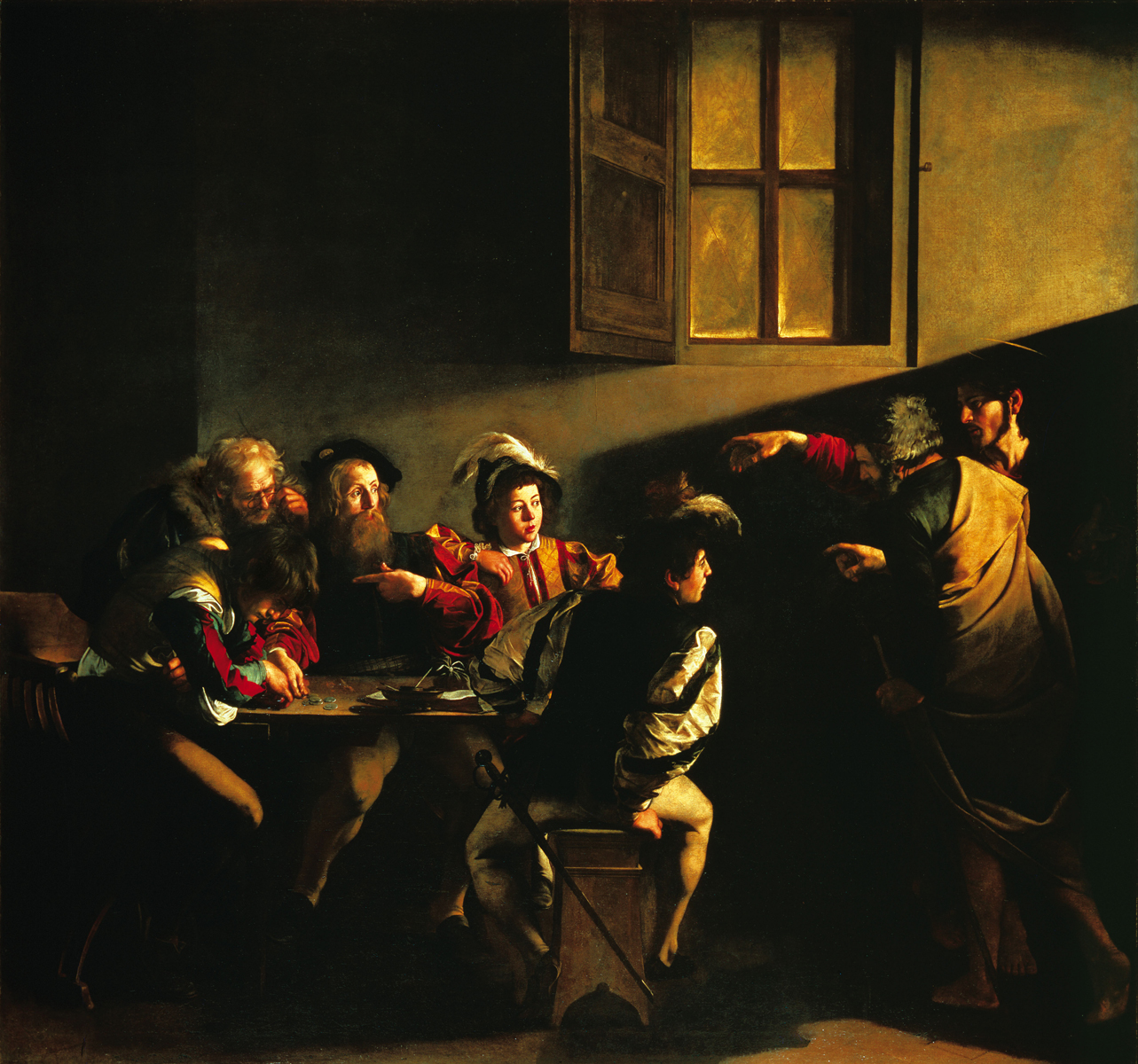
One of the Best. Paintings. Ever.

In honor of today, the feast of St. Matthew, behold Caravaggio's The Calling of St. Matthew:


If you've never seen the original, add it to your own personal List of Things I Must Do Before I Die. It's in the Church of San Luigi dei Francesi in Rome, which is home to two other [!] Caravaggios as well, both of which also feature St. Matthew.

Wednesday, September 9, 2009

Breastfeeding in a Pornified Culture

"I just don't think it's proper for women to show their breasts out in public unless they're on the beach."

So said some middle-aged guy who happened upon a group of mothers taking part in a "nurse-in" in Lincoln Square Plaza last Friday in support of a fellow breastfeeding mom who was harassed (sadly, by another mom) earlier in the week.

On the one hand, this guy's comments are boorish, obnoxious, and stupid.

But on the other hand, I have to give him credit for being so up-front about his "issue" with nursing. I've heard not a few times from my beloved wife that people have told her they're "uncomfortable" with her nursing in public, but invariably the objectors fail to subsequently explain why, precisely, it disrupts their comfort level.

I'm of the opinion that nursing in public is often perceived to be indecent because it is (and has been for quite some time) done relatively rarely, due in no small part to the recommendations of a Herd of Indepdendent Thinkers who decided in the middle of the last century that the idea that babies should be fed formula somehow marked a crowning achievement for human civilization.

I say "relatively rarely" in reference to the portrayal of women's breasts as sexual, which is surely the norm in our pornified culture.

In essence, then, to the modern mind, whose perspective our boorish commenter articulates to a T, the "real" — i.e., the belief that women's breasts are primarily for nursing her children — has been replaced by the "counterfeit" — i.e., the belief that women's breasts are primarily, if not exclusively, sexual.

(As an aside: Much the same can be said of contraception and its impact on people's attitudes toward sex. To the modern mind, the "real"—i. e., the belief that openness to having a child is an essential component of sex—has been replaced by the "counterfeit"—i. e., the belief that contraceptive sex is the norm.)

It follows that those of us who believe the opposite—that the real is actually the counterfeit and vice versa—are often considered daft.

My sense is that were public nursing to be done ubiquitously, this wacky popular notion that it is indecent would wane.

[HT: R.M. Schultz via Carrie W.]

Tuesday, June 2, 2009

Christopher West

I first heard about Christopher West's appearance on Nightline a few weeks ago, but it wasn't until last week that I (a) saw the actual segment for myself, and (b) learned that many in the Catholic blogosphere have subsequently released the hounds on him.

Here's the segment in question:


Contrast that with this:


West has been getting pilloried by many fellow Catholics — treatment which is, in my opinion, grossly unfair.

If ABC's portrayal of West and his understanding of Catholic theology and sexuality were accurate, and if none of his statements had been taken out of context, it would be justified to give him Hail Columbia.

But it's not, and many of them were; and thus it isn't.

Recently Professor David Schindler offered a strong critique of West here, to which Professor Janet Smith (for whom I personally have tremendous respect as a Catholic moral theologian) and Professor Michael Waldstein offered their respective responses in defense of West's work here and here.

The best critique I've come across is from Jimmy Akin, who rightly cuts West a lot of slack:


Christopher West has a difficult job. As a chastity speaker, he's got to juggle several things at once:

1) He's got a very sensitive subject
2) On which different audiences have different sensibilities
3) The audience that most needs his message is very hard to reach
4) Part of the reason why they're so hard to reach is that they have a pre-existing stereotype of Christian sexual morality that they think gives them a license to tune out anything a Christian says on the subject
5) To reach this group you have to effectively batter your way past this anti-Christian prejudice and get them to take you seriously while simultaneously
6) Not offending the sensibilities of those who already take Christian sexual morality seriously
7) Some of whom have rigorist views on the topic


Through my job, I occasionally give chastity talks to junior high and high school teenagers, and thus I found myself nodding my head repeatedly as I read through this list.

Communicating the message of chastity takes a lot of thought and preparation — not to mention prayer — and figuring out the best way to do so is something I'm continually revisiting. (It's for this reason that when I do give chastity talks, I prefer that kids' parents be present also. Aside from the fact that parents are their children's primary educators — especially when it comes to such a crucial subject matter as sex — it also gives me a chance to hear feedback from moms and dads, which greatly helps me assess the degree to which I was able to "juggle" the various things on the aforesaid list.)

While I think it could be said that there are some "issues" with some aspects of Christopher West's speaking style — referring to Song of Songs as the "centerfold" of the Bible, for example, which Jimmy Akin addresses in his critique — in the end I agree with him that "West is a man on the side of the angels, and he's an effective speaker who has done a great deal of good."

Wednesday, April 15, 2009

Religion Devoid of Holidays Is No Religion At All

I'm told that Archbishop Fulton Sheen once said:

I heard of one man who was an atheist for a year and then he gave it up because there were no holidays.


During Easter Week, these words are especially poignant.

I've always been struck by a certain sadness when I hear of particular Protestants who go to great lengths to argue against celebrating holidays like Christmas and Easter.

The implication of Sheen's quip is that authentic religion must necessarily include the celebration of holidays.

And, as usual, he's right.

We all know, of course, that the "Chreasters" who attend Mass twice a year are not the ideal practicioners of the Faith. (Then again, can any of us legitimately lay claim to embodying the characteristics of an ideal disciple of Our Lord Jesus Christ?)

Still, the fact that our churches are filled with such as these on the two most important days of the year is itself a testimony to the burning need of the human heart to regularly visit a sacred place and recall particularly significant sacred events in a communal setting.

God certainly knew what He was doing when He made His people a liturgical people.

Tuesday, April 14, 2009

SoulWow

When it comes to evangelization, I'm a big believer in meeting people where they're at.

That's why I think this* is an absolutely brilliant ad campaign:


Now, for the important question: Is it working?

Yes:

Officials in the dioceses of Brooklyn and Rockville Centre acknowledge the piece is a bit "edgy," but they say they needed to grab Catholics' attention to get them back into the confessional booth - especially during Holy Week...

The newly released "Soul Wow" video was a hit, church officials said, and along with a companion print and radio campaign has helped boost the number of people who went to confession during Holy Week this year. The two dioceses sponsored the campaign jointly.

"Confessions were very, very heavy," said the Rev. Kieran Harrington of the Diocese of Brooklyn. "We feel it was very successful."

Like Brooklyn, the Diocese of Rockville Centre, home to 1 1/2 million Catholics, does not keep precise statistics on the number of people attending confession. But officials also said anecdotal evidence indicated a sharp uptick this year. [emphasis added]


* See the ShamWow ad that this ad spoofs here.

Thursday, April 9, 2009

"Ecce Homo"

As we prepare over the next few days to commemorate the events that comprise the pivot on which everything else turns, I've included herein a reflection on Our Lord Jesus Christ's final hours from G.K. Chesterton's The Everlasting Man — the book that helped to make a Christian out of a young atheist named C. S. Lewis.

As we enter into the Triduum, this excerpt from a chapter titled "The Strangest Story in the World" reminds us of the significance of the events we prepare to recall:

When Jesus was brought before the judgement-seat of Pontius Pilate, he did not vanish. It was the crisis and the goal; it was the hour and the power of darkness. It was the supremely supernatural act, of all his miraculous life, that he did not vanish.

Every attempt to amplify that story has diminished it. The task has been attempted by many men of real genius and eloquence as well as by only too many vulgar sentimentalists and self-conscious rhetoricians. The tale has been retold with patronising pathos by elegant sceptics and with fluent enthusiasm by boisterous best-sellers. It will not be retold here. The grinding power of the plain words of the Gospel story is like the power of mill-stones; and those who can read them simply enough will feel as if rocks had been rolled upon them. Criticism is only words about words; and of what use are words about such words as these? What is the use of word-painting about the dark garden filled suddenly with torchlight and furious faces? 'Are you come out with swords and staves as against a robber? All day I sat in your temple teaching, and you took me not.' Can anything be added to the massive and gathered restraint of that irony; like a great wave lifted to the sky and refusing to fall? 'Daughters of Jerusalem, weep not for me but weep for yourselves and for your children.'

As the High Priest asked what further need he had of witnesses, we might well ask what further need we have of words. Peter in a panic repudiated him: 'and immediately the cock crew; and Jesus looked upon Peter, and Peter went out and wept bitterly.' Has anyone any further remarks to offer? Just before the murder he prayed for all the murderous race of men, saying, 'They know not what they do'; is there anything to say to that, except that we know as little what we say? Is there any need to repeat and spin out the story of how the tragedy trailed up the Via Dolorosa and how they threw him in haphazard with two thieves in one of the ordinary batches of execution; and how in all that horror and howling wilderness of desertion one voice spoke in homage, a startling voice from the very last place where it was looked for, the gibbet of the criminal; and he said to that nameless ruffian, 'This night shalt thou be with me in Paradise'? Is there anything to put after that but a full stop? Or is anyone prepared to answer adequately that farewell gesture to all flesh which created for his Mother a new Son?

It is more within my powers, and here more immediately to my purpose, to point out that in that scene were symbolically gathered all the human forces that have been vaguely sketched in this story. As kings and philosophers and the popular element had been symbolically present at his birth, so they were more practically concerned in his death; and with that we come face to face with the essential fact to be realised. All the great groups that stood about the Cross represent in one way or another the great historical truth of the time; that the world could not save itself. Man could do no more. Rome and Jerusalem and Athens and everything else were going down like a sea turned into a slow cataract. Externally indeed the ancient world was still at its strongest; it is always at that moment that the inmost weakness begins. But in order to understand that weakness we must repeat what has been said more than once; that it was not the weakness of a thing originally weak. It was emphatically the strength of the world that was turned to weakness and the wisdom of the world that was turned to folly.

In this story of Good Friday it is the best things in the world that are at their worst. That is what really shows us the world at its worst. It was, for instance, the priests of a true monotheism and the soldiers of an international civilisation. Rome, the legend, founded upon fallen Troy and triumphant over fallen Carthage, had stood for a heroism which was the nearest that any pagan ever came to chivalry. Rome had defended the household gods and the human decencies against the ogres of Africa and the hermaphrodite monstrosities of Greece. But in the lightning flash of this incident, we see great Rome, the imperial republic, going downward under her Lucretian doom. Scepticism has eaten away even the confident sanity of the conquerors of the world. He who is enthroned to say what is justice can only ask: 'What is truth?' So in that drama which decided the whole fate of antiquity, one of the central figures is fixed in what seems the reverse of his true role. Rome was almost another name for responsibility. Yet he stands for ever as a sort of rocking statue of the irresponsible. Man could do no more. Even the practical had become the impracticable. Standing between the pillars of his own judgement-seat, a Roman had washed his hands of the world.

There too were the priests of that pure and original truth that was behind all the mythologies like the sky behind the clouds. It was the most important truth in the world; and even that could not save the world. Perhaps there is something overpowering in pure personal theism; like seeing the sun and moon and sky come together to form one staring face. Perhaps the truth is too tremendous when not broken by some intermediaries divine or human; perhaps it is merely too pure and far away. Anyhow it could not save the world; it could not even conquer the world. There were philosophers who held it in its highest and noblest form; but they not only could not convert the world, but they never tried. You could no more fight the jungle of popular mythology with a private opinion than you could clear away a forest with a pocket-knife. The Jewish priests had guarded it jealously in the good and the bad sense. They had kept it as a gigantic secret. As savage heroes might have kept the sun in a box, they kept the Everlasting in the tabernacle. They were proud that they alone could look upon the blinding sun of a single deity; and they did not know that they had themselves gone blind. Since that day their representatives have been like blind men in broad daylight, striking to right and left with their staffs, and cursing the darkness. But there has been that in their monumental monotheism that it has at least remained like a monument, the last thing of its kind, and in a sense motionless in the more restless world which it cannot satisfy. For it is certain that for some reason it cannot satisfy. Since that day it has never been quite enough to say that God is in his heaven and all is right with the world, since the rumour that God had left his heavens to set it right.

Friday, March 13, 2009

Obama, Camille Paglia, and Groupthink

My fellow Catholic Dads blogger Nod has a great post regarding some comments made recently by Camille Paglia about the Obama administration.

I would have loved to have written more in the comments section thereof, but hadn't the time, so I focused very briefly on one question he raised, which, it seems to me, is a terribly important one:

Why do so many fall into the trap of groupthink and blithe rationalizations?


To which I wrote:

The short answer, it seems to me, is:

Because it's easy. Resisting groupthink, on the other hand, is hard.

And most of us are lazy.

Monday, September 22, 2008

Du Bist Deutschland

On my last post, one Santiago Chiva posted the following comment, at the end of which was a link to an uber-cool video:

On the topic of abortion, even many people who defend the possibility of legal abortions, they say they are not pro-abortion, but they don’t want to punish women who are in this difficult situation. In Germany a curious thing has happened. Something that reflects that legal abortion affects adversely to the country. And also that the change is possible: you can promote a culture of life with the support of the citizens, when really there is a real wish of avoid abortions. Since the liberalization of abortion in this country, the number of abortions is officially four million. For that reason, among others, children are seen as an unintended effect of having sex. Many people thought it was necessary to promote greater social acceptance of children in an aging society. And civil society acted, without waiting for action by the State to promote births. They joined several media organizations in a campaign. Interestingly, after the campaign, the birth rate has risen in Germany. The video is exciting. Look here:


Friday, August 22, 2008

Very Sad

There's a powerful story recently in the Daily Mail about Elizabeth Cameron (a pseudonym) who was raped at age 16, became pregnant, and despite everyone except her mother trying to convince her to have an abortion, kept her baby.

Perhaps the saddest part of the article is this:

Very few people know the truth of how Phoebe [Elizabeth's daughter] came to exist. Unfortunately, in their community, it is assumed that she is just another youngster who got pregnant through carelessness, foolishness or deliberate willfulness.

'At college, one of my tutors even asked if I'd got pregnant deliberately so I could get a council flat.'

Her mother shakes her head. 'Most people don't know the gory facts. To them, she is just a silly girl who got herself pregnant.

'We had always been regular churchgoers in our community before this. But we faced so many barbed comments from people at church that we stopped going there and went somewhere else. Sometimes, it has felt like me and Elizabeth against the rest of the world.'

Tuesday, July 22, 2008

Heh

From Stuff White People Like:

Being a truly advanced white person means being able to speak with authority about pretty much any field of conversation- especially politics. In order for white people to streamline the process of knowing everything, all human beings can be neatly filed into one of two categories: People I Agree With, and People Who are Just Like Adolf Hitler.

Comparing people to Hitler is an easy way for white people to get a strong point across to the less enlightened, or the insufficiently white...

This time-tested white-person maneuver may seem so awesomely useful to you that you are tempted to go out and try it right now. Not so fast. White people have spent the last 30 years perfecting this technique. There are cultural guidelines.

It’s also critical that you avoid the fatal mistake of getting creative and comparing people you don’t like to other evil dictators, such as Joseph Stalin or Fidel Castro. With few exceptions, white people are actually fond of almost any dictator not named Hitler, and your remark that “this is just like something Mao Zedong would do” will be met with blank stares and possible social alienation. This is because, with the exception of Hitler, oppressive dictators share a passion for many of the things white people love- such as universal health care, conspiracy theories, caring about poor people while being filthy rich, and cool hats.


Of course, white people aren't alone here.

I'm reminded of the Colombian hostage rescue earlier this month, during which some of the country's security forces posing as FARC rebels wore Che Guevara T-shirts as part of their elaborate ruse.

This, in turn, prompted me to recall this satire thereof:

Wednesday, May 28, 2008

On Imbibing

Halfway through the drinking decalogue, we see this:

5. Thou Shalt Learn to Appreciate All Forms of Beer - If Natty Light, Keystone and Coors are your idea of what beer is and is meant to be, you’re living your drinking-life like that of a child in sub-Saharan Africa. Bring that inner impoverished child into the “civilized” world and open your dry crusty wind-chapped eyes to the world of ambers, stouts, saisons, hefeweissens and the multitude of heavenly hops-angels just waiting to surround you and give you a glimpse of the Promised Land. While you’re still getting over your silly stigma that Guinness is a “heavy” beer and cringing at the thought of a slice of lemon in your Hoegaarden, the rest of us will be happily melting our brains away into oblivion. With the superhot hops-angels, of course.


I also like this one:

9. The Way You Treat Bartenders and Waitstaff Says More About You Than You Know ...Snapping, clapping, yelling, whistling or just general rudeness to someone waiting on you are a sure sign to anyone in your company that if they spend enough time around you, you’ll eventually treat them with the same selfish nonchalance and disdain that you treat those who are paid to be nice to you. And for crying out loud, TIP WELL.


Tip well, indeed.

Maybe it's because both of my brothers worked as bartenders at one time in their lives, but I'm of the opinion that tipping anything less than a dollar a drink is unacceptable.

I would take it one step further regarding how you ought to treat someone waiting on you:

Failing to say "Thank you" when your server brings you something (a drink, your food, a utensil, extra napkins, the bill, etc.) is boorish in and of itself. There are few actions that annoy me more than when someone says nothing when he is brought something by his server.

Servers are not soulless automatons whose raison d'ĂȘtre is to Take Orders And Bring People Things.

They're people, and they deserve to be treated as such.

[HT: The Blue Boar via The Daily Eudemon]

Tuesday, April 8, 2008

You Gotta Love the Irony

Last Wednesday, at a General Assembly hearing in the Capitol building of our fair corrupt state, the following exchange took place between Ill Rep. Monique Davis (D-Chicago) and longtime atheist activist Rob Sherman (the latter is currently suing the State of Illinois over its moment of silence in public schools law):

Davis: I don’t know what you have against God, but some of us don’t have much against him.  We look forward to him and his blessings. And it’s really a tragedy -- it’s tragic --  when a person who is engaged in anything related to God, they want to fight.  They want to fight prayer in school. 


I don’t see you (Sherman) fighting guns in school. You know?


I’m trying to understand the philosophy that you want to spread in the state of Illinois. This is the Land of Lincoln. This is the Land of Lincoln  where people believe in God, where people believe in protecting their children.… What you have to spew and spread is extremely dangerous, it’s dangerous--


Sherman: What’s dangerous, ma’am?


Davis: It’s dangerous to the progression of this state. And it’s dangerous for our children to even know that your philosophy exists! Now you will go to court to fight kids to have the opportunity to be quiet for a minute. But damn if you’ll go to  [court] to fight for them to keep guns out of their hands. I am fed up! Get out of that seat!


Sherman: Thank you for sharing your perspective with me, and I’m sure that if this matter does go to court---


Davis: You have no right to be here! We believe in something. You believe in destroying! You believe in destroying what this state was built upon.


(The audio is here, courtesy of the Illinois Information Service.)

Here's what I found particularly ironic about the the whole thing:

Rob Sherman is pro-life.

Monique Davis is "pro-choice".

Now, Sherman is no stranger to this sort of decidedly un-Christian treatment from Christians. (Last fall, for example, his house got egged by vandals who wrote "JESSUS" [sic] in big yellow letters in his driveway.)

Maybe it's because I've met Sherman before (he had me on his radio show last fall because my boss, Joe Scheidler, a longtime friend of his, was originally supposed to be on, but then ended up going out of town and asked me to fill in for him), and because I can't help but like him that I find hearing about extraordinarily obnoxious things said to him by Christians to be so troubling.

I'm gonna go out on a limb here, but maybe, just maybe, acting boorishly toward atheists may not be a very effective way to win them over.